A Volatile Week Driven by Nvidia Expectations and Heavy Data Flow
The week opened with broad declines across the S&P 500, Dow Jones, and Nasdaq 100, each sliding to fresh multi-week lows. It wasn’t a single catalyst driving the weakness but rather a collision of anticipation and uncertainty. Nvidia’s earnings were the focal point, viewed as a market-wide stress test for the entire artificial intelligence narrative. Investors needed proof that massive spending on AI infrastructure and premium tech valuations still made sense.
At the same time, the market braced for an unusually dense schedule of delayed economic releases. Reports covering employment, industrial output, housing activity, trade, and consumer sentiment were all stacked within a few days, adding another layer of tension. Even supportive news—such as a strong Empire Manufacturing reading or Berkshire Hathaway’s stake in Alphabet—offered only temporary relief.
Pressure Builds on Big Tech and Crypto-Exposed Stocks
Large-cap tech dragged the broader indexes throughout the week. Amazon and Microsoft were hit with downgrades, and the rest of the “Magnificent Seven” faded alongside them. Nvidia, Tesla, Meta, Alphabet, and Apple all logged back-to-back red sessions.
Chipmakers faced even more violent selling. Valuations had climbed so quickly in recent months that any hesitation led to fast and deep unwinding. Names like Micron, AMD, Marvell, Applied Materials, ASML, and Lam Research saw losses range from three to ten percent in a single day. Traders clearly reassessed how much they were willing to pay for long-dated AI growth.
Crypto added another layer of stress. Bitcoin slumped to a seven-month low and extended its six-week decline to over 30% from last month’s peak. Coinbase, MicroStrategy, Riot, Galaxy Digital, and MARA sank further, intensifying the “risk-off” sentiment.
The Fed Becomes the Central Character
The major swing factor was the shifting expectation for the December FOMC meeting. The probability of another 25-basis-point cut moved wildly between 30% and 60% depending on each new data point or Fed comment.
Soft pockets in the labor market and easing inflation expectations supported bets on additional cuts. Rising continuing jobless claims and downward revisions to consumer sentiment helped reinforce the idea that policy might loosen again.
But the Fed consistently pushed back. Multiple officials signaled caution, and the cancellation of key October inflation and employment releases removed a large portion of visibility ahead of the December meeting. The FOMC minutes showed that many members preferred keeping rates steady through the end of the year.
This back-and-forth drove sharp moves in both equities and Treasury yields throughout the week, keeping volatility elevated even in sessions with otherwise light catalysts.
Chipmakers Stage a Sudden Comeback
After a brutal selloff on Thursday—when Nvidia and the entire AI-linked complex sank following hawkish Fed commentary—the semiconductor space staged a sharp reversal on Friday.
The rebound reflected two things. First, the underlying demand story for chips remains structurally strong. Second, New York Fed President John Williams’ dovish comments revived hopes for another rate cut and quickly drove yields lower.
As yields fell toward three-week lows, the entire market felt relief. Indices climbed off their intraday lows, and the week ended with a strong rally in chipmakers, which pulled the broader market higher despite lingering concerns over valuations.
Sector Divergence Widens
While tech struggled, several traditional sectors benefited from falling bond yields. Homebuilders and housing-related suppliers posted solid gains as mortgage-sensitive assets snapped higher in response to lower rates.
At the same time, individual corporate stories continued to matter. Retailers, select industrials, energy names tied to long-term contracts, and companies benefiting from M&A activity delivered strong upside surprises. But these isolated gains couldn’t overshadow the broad weakness emanating from mega-cap tech and AI infrastructure stocks earlier in the week.
What It Means Going Forward
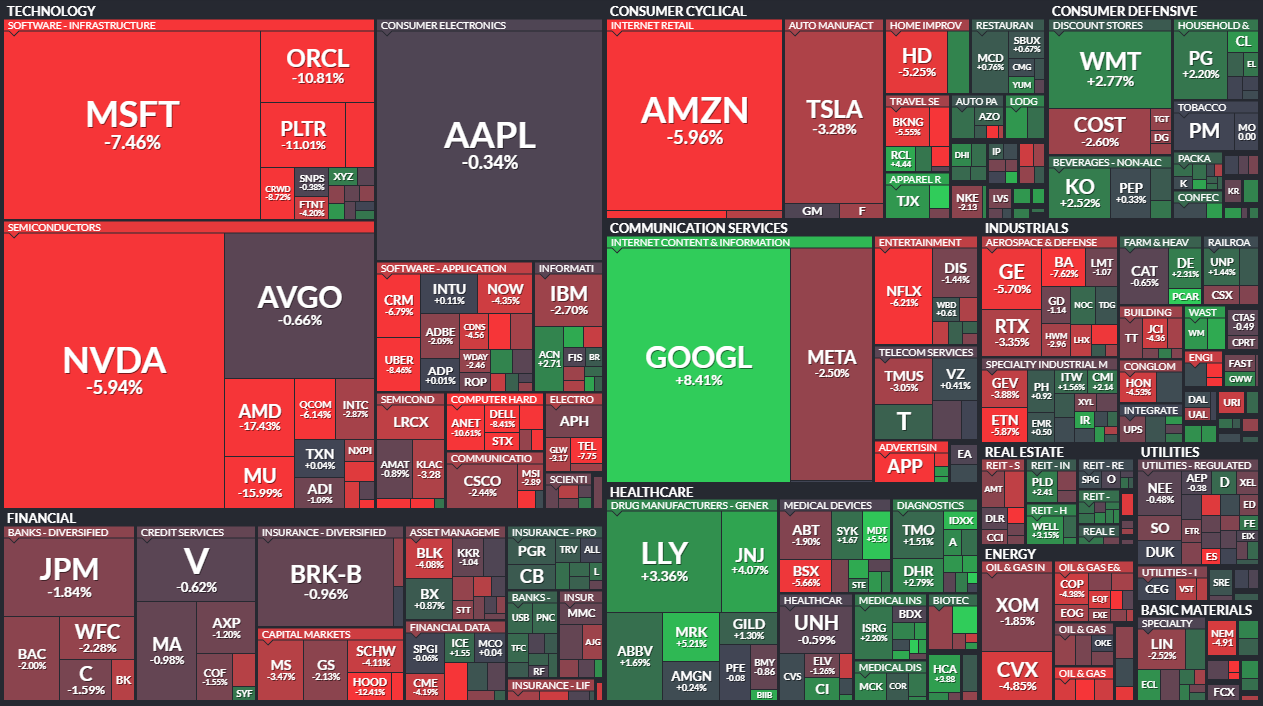
The current environment doesn’t resemble the beginning of a market breakdown. Instead, it looks like a painful repricing of expectations. Corporate earnings remain surprisingly strong, with more than eighty percent of S&P 500 companies beating forecasts, and profit growth nearly doubling expectations.
However, tech and AI stocks have soared so quickly this year that even excellent results no longer guarantee continued price appreciation. Investors are shifting from broad thematic buying to more selective positioning, emphasizing cash flow strength, margin stability, and realistic guidance.
The bond market has re-entered the spotlight. Changes in the 10-year Treasury yield and tone from the Fed now move equities as powerfully as individual company earnings. Nvidia, the Fed, and the incoming macro data have pushed markets into a phase where risk management matters more than chasing the next big narrative.
Subscribe to stay up to date with the latest events in the financial markets.
Telegram: @bigstakeinvest
Twitter: @BigStakeTrades
Telegram: @bigstakeinvest
Twitter: @BigStakeTrades