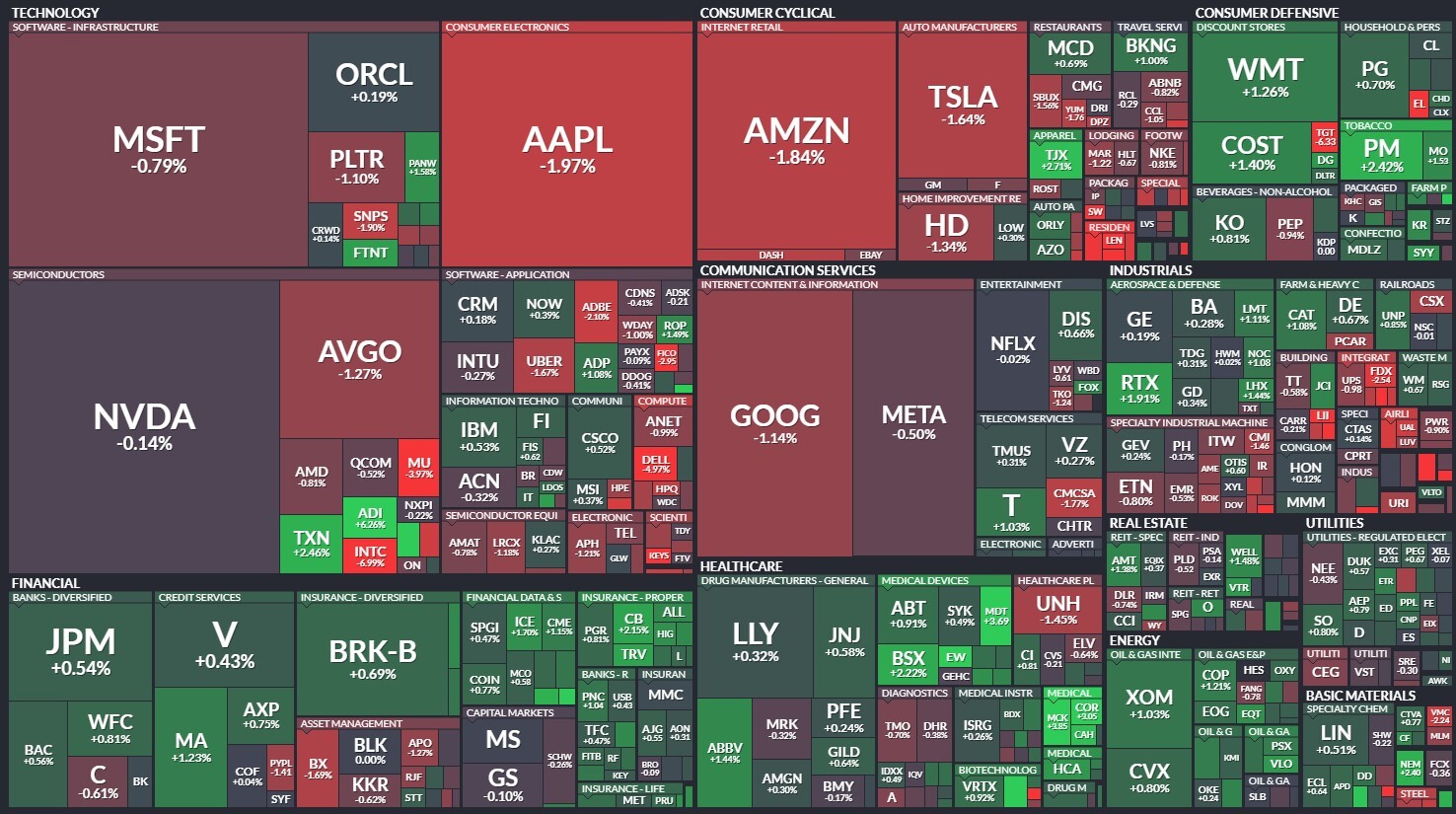
US stock indexes closed mostly lower on Wednesday, extending the previous session’s slide. The S&P 500 fell -0.24% to a 1.5-week low, the Nasdaq 100 dropped -0.58% to a 2-week low, while the Dow Jones managed to rise +0.04%, supported by Walmart.
The biggest drag came from the technology sector. The "Magnificent Seven" (Apple, Alphabet, Amazon, Tesla, Microsoft, Meta, and Nvidia) all ended in the red, while semiconductor stocks plunged. Intel dropped over -6%, Micron lost -3%, and ARM slid more than -2%.
Corporate news added further pressure. Target sank more than -6% after forecasting a larger-than-expected decline in annual sales, and Estee Lauder fell over -3% on a weak 2026 EPS outlook. In contrast, Walmart rose more than +1% ahead of its Q2 earnings report due Thursday, with investors expecting stronger-than-estimated comparable-store sales.
The July 29–30 Fed minutes showed policymakers remain more concerned about inflation risks than labor market weakness. This dampened expectations for aggressive rate cuts: the probability of a -25 bp cut in September now stands at 84%, down from 93% last week.
Adding to uncertainty were new tariff measures from President Trump. On Monday, expanded duties on steel and aluminum products took effect, covering auto parts, furniture components, and even tableware. Trump also announced plans for 100–300% tariffs on semiconductors, with exemptions for firms shifting production to the US. In addition, tariffs on imports from India were doubled, and new duties on pharmaceuticals are expected soon. Bloomberg Economics estimates the average US tariff could rise to 15.2%, compared with just 2.3% in 2024.
Overseas markets were mixed: European equities closed lower, Japan’s Nikkei dropped -1.5%, while China’s Shanghai Composite gained +1.04%, hitting a 10-year high.
This week, investors are watching macro data including jobless claims, the Philadelphia Fed survey, and existing home sales. The spotlight, however, will be on Fed Chair Jerome Powell’s speech at Jackson Hole on Friday, which could set the tone for monetary policy in the months ahead.
Despite near-term pressures, Q2 earnings season has been much stronger than expected. Profits for S&P 500 companies are on track to rise +9.1% y/y, the best in four years and far above the +2.8% initially forecast. Roughly 83% of companies have beaten earnings estimates.
The biggest drag came from the technology sector. The "Magnificent Seven" (Apple, Alphabet, Amazon, Tesla, Microsoft, Meta, and Nvidia) all ended in the red, while semiconductor stocks plunged. Intel dropped over -6%, Micron lost -3%, and ARM slid more than -2%.
Corporate news added further pressure. Target sank more than -6% after forecasting a larger-than-expected decline in annual sales, and Estee Lauder fell over -3% on a weak 2026 EPS outlook. In contrast, Walmart rose more than +1% ahead of its Q2 earnings report due Thursday, with investors expecting stronger-than-estimated comparable-store sales.
The July 29–30 Fed minutes showed policymakers remain more concerned about inflation risks than labor market weakness. This dampened expectations for aggressive rate cuts: the probability of a -25 bp cut in September now stands at 84%, down from 93% last week.
Adding to uncertainty were new tariff measures from President Trump. On Monday, expanded duties on steel and aluminum products took effect, covering auto parts, furniture components, and even tableware. Trump also announced plans for 100–300% tariffs on semiconductors, with exemptions for firms shifting production to the US. In addition, tariffs on imports from India were doubled, and new duties on pharmaceuticals are expected soon. Bloomberg Economics estimates the average US tariff could rise to 15.2%, compared with just 2.3% in 2024.
Overseas markets were mixed: European equities closed lower, Japan’s Nikkei dropped -1.5%, while China’s Shanghai Composite gained +1.04%, hitting a 10-year high.
This week, investors are watching macro data including jobless claims, the Philadelphia Fed survey, and existing home sales. The spotlight, however, will be on Fed Chair Jerome Powell’s speech at Jackson Hole on Friday, which could set the tone for monetary policy in the months ahead.
Despite near-term pressures, Q2 earnings season has been much stronger than expected. Profits for S&P 500 companies are on track to rise +9.1% y/y, the best in four years and far above the +2.8% initially forecast. Roughly 83% of companies have beaten earnings estimates.
Subscribe to stay up to date with the latest events in the financial markets.
Telegram: @bigstakeinvest
Twitter: @BigStakeTrades
Telegram: @bigstakeinvest
Twitter: @BigStakeTrades