Sharp Index Selloff: What Happened on Thursday
The US stock market on Thursday closed with a steep decline across almost all major indices. The S&P 500 lost around one and a half percent, the Dow Jones fell by a similar amount, and the tech-heavy Nasdaq 100 dropped by more than two percent, underscoring the pressure on growth and high-tech names.
The decline came alongside deteriorating sentiment around future Fed policy and investors’ reaction to the upcoming macroeconomic data releases, which were delayed by the recent government shutdown. The market is increasingly pricing in a scenario where the Fed is in no hurry to cut rates further and may even opt for a prolonged pause.
Index futures also moved lower, locking in expectations of further volatility and caution among market participants ahead of the December Fed meeting.
Why Bond Yields Jumped and Why That Hurts Stocks
The key pressure point for equities was the rise in US Treasury yields. The 10-year yield climbed to just above 4.1%, adding several basis points on the day. For the stock market this is a double blow: so-called “risk-free” returns become more attractive, while financial conditions for companies tighten.
The move was triggered by hawkish comments from Fed officials. The heads of the Boston, Cleveland, and St. Louis Fed banks signaled that they see little reason to continue cutting rates aggressively. Their core message was that further policy easing could make monetary conditions “overly accommodative” against the backdrop of still elevated and sticky inflation.
The derivatives market immediately repriced the expected rate path. The probability of another cut at the upcoming meeting fell to roughly 50%, whereas a week earlier traders were confidently betting on a dovish Fed. For equities, this is a clear signal: cheap money is no longer a given, and the required risk premium has to rise.
Government Shutdown Ends: Relief Without Euphoria
Formally, the end of the longest US federal government shutdown in history was a positive headline. The President signed a bill restoring funding for agencies, bringing federal employees back to work and resuming transfers to states and local authorities.
However, the market treated this more as the removal of a tail risk than a trigger for a rally. Congress has already received an estimate from the Congressional Budget Office suggesting that the six-week shutdown will shave growth off current-quarter GDP, although part of the lost activity should be recovered later thanks to back pay and the resumption of programs.
Adding to nervousness is the fact that key economic statistics on employment and inflation are now coming out with a delay. Investors temporarily lack a clear compass for the state of the labor market and price dynamics, and the Fed is forced to make decisions in an environment of elevated uncertainty.
Outside the US: Moderately Negative Backdrop
European equity markets looked weaker than the US and recorded modest declines after the Euro Stoxx 50 refreshed all-time highs. Investors in the euro area reacted to soft industrial production data and caution around the European Central Bank’s next steps.
Yields on German and UK government bonds also moved higher, extending the global trend of rising long-end rates. In the UK, weak readings on industrial output and GDP reinforced the story of sluggish growth.
In Asia, the backdrop was more mixed. Chinese equities advanced and updated a local high, while Japan’s Nikkei continued to grind higher, helped by a weak yen and steady demand for exporters’ stocks. Still, it was the US that set the tone for the day globally – and that tone was corrective.
Hit to Tech and Chipmakers
Semiconductor companies found themselves on the front line of the selloff. Shares of ARM, Intel, Lam Research, Broadcom and a whole range of other chipmakers were down three to five percent or more during the session. For a sector that had previously led the market higher, this looks like a painful but fairly logical bout of profit-taking after a strong rally.
Investors were locking in gains in richly valued stories against the backdrop of rising bond yields, since tech is the sector most sensitive to the cost of money in the future. The higher the discount rate, the harsher the market treats companies whose earnings are concentrated far out on the horizon.
Members of the famed “Magnificent Seven” were also under pressure. Tesla fell the most, dropping more than six percent. Nvidia and other large-cap tech names also ended the day lower by one to three percent. Only Meta managed to close with a symbolic gain, which looks more like an exception than the start of a new trend.
Mixed Picture on Corporate Earnings
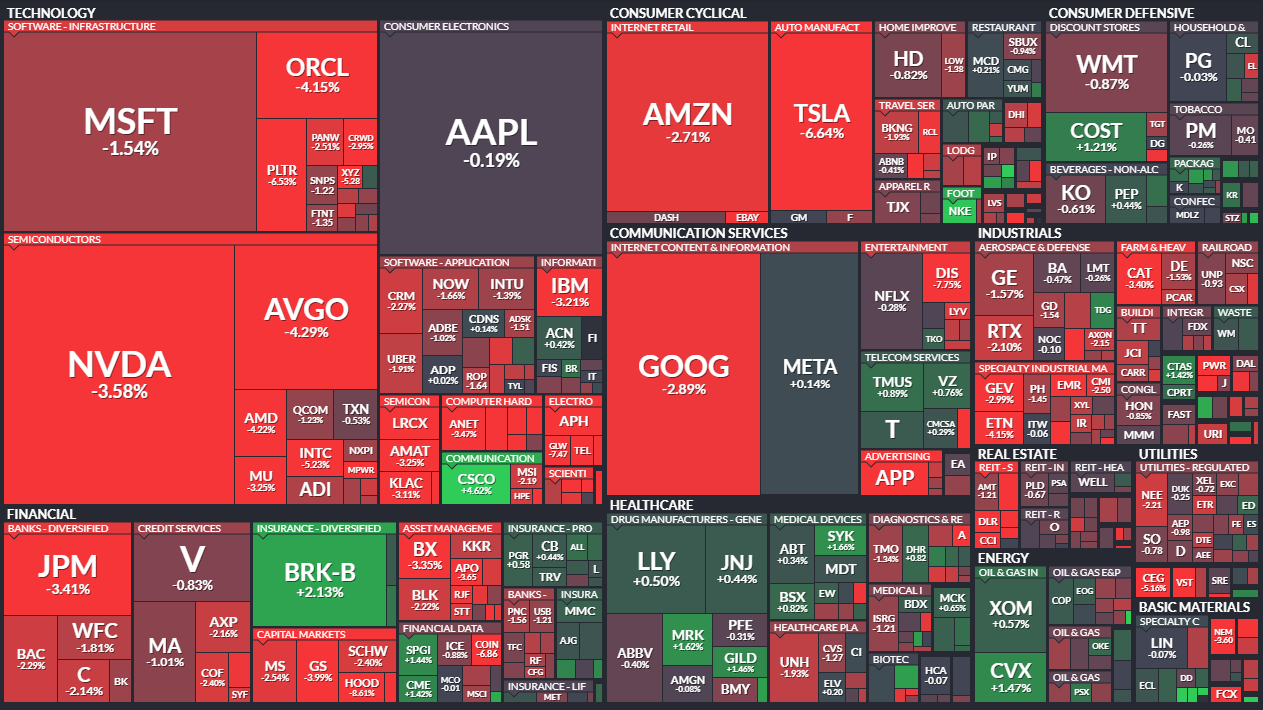
From a fundamental standpoint, the earnings season looks much better than the market mood on this particular day. Most S&P 500 companies have already reported, and the share of those beating expectations is well above 80%. Year-on-year earnings growth is in double digits and has more than doubled the initial forecasts of analysts.
Yet the reaction at the single-stock level remains harsh. Weak guidance or disappointing revenue figures are punished immediately. Ardent Health plunged by more than a third after cutting its EBITDA outlook. Online platforms Webtoon and Ibotta were also heavily sold after issuing soft revenue guidance for the next quarter.
Disney became one of the main laggards of the day: disappointing revenue numbers triggered a drop of more than seven percent and pushed the stock to the bottom of both the S&P 500 and the Dow. Once again, the market showed that it has little tolerance for weak fundamentals, even when it comes to iconic brands.
Where Demand Did Appear: Select Winners
Despite the broad selloff, there were pockets of strength. Sealed Air rallied sharply after news of a potential M&A deal from a private equity firm. Firefly Aerospace jumped more than ten percent on the back of stronger-than-expected revenue and plans to resume rocket launches.
Retailer Dillard’s impressed with earnings per share well above expectations, which also attracted buyers. In tech, Cisco stood apart: the company raised its revenue forecast for 2026, allowing the stock to become one of the few gainers in the Dow and the Nasdaq 100.
There was also interest in select names in the materials space. Albemarle received a price-target upgrade from an investment bank, which supported the lithium producer’s stock after a prolonged period of pressure.
What This Means for Investors and What to Watch Next
The trading session is a textbook example of how shifting expectations around Fed policy can overshadow even a very solid earnings season. As long as bond yields hover around 4% and above, and Fed officials talk about “limited room” for further rate cuts, any hope for a return to ultra-cheap money will run into hard reality.
For medium-term investors, this is a signal to be disciplined on valuation and avoid overpaying for growth stories that already trade on high multiples and are particularly rate-sensitive. Semiconductors and mega-cap “Mag7” names remain the main volatility drivers: the market uses them to rapidly reprice expectations for future profit growth.
At the same time, the underlying earnings data do not yet support an immediate recession narrative. This looks more like a phase of repricing the rate path and discount rates than the start of an economic collapse. The next leg for markets will depend on how soft or tough the delayed inflation and employment reports turn out to be, as well as on the Fed’s rhetoric in the run-up to the December meeting.
Subscribe to stay up to date with the latest events in the financial markets.
Telegram: @bigstakeinvest
Twitter: @BigStakeTrades
Telegram: @bigstakeinvest
Twitter: @BigStakeTrades