US Stocks Turn Lower as Semiconductor Sector Pulls Back
On Tuesday, US stock indexes finished in negative territory: the S&P 500 lost 0.38%, the Nasdaq 100 fell 0.55%, and the Dow Jones slipped 0.20%. After an early rally to new all-time highs, markets reversed as investors took profits in semiconductor stocks.
Leaders of Monday’s rally, including Advanced Micro Devices, retreated slightly, though AMD still gained another 3% following a rating upgrade from Jeffries and optimism surrounding its deal with OpenAI. The move came after a 23% surge the previous day.
Strong expectations for growth in artificial intelligence remain a key long-term driver for the market. However, in the short term, sentiment weakened amid hawkish comments from Federal Reserve officials and growing uncertainty surrounding the prolonged US government shutdown, now in its second week.
Fed Officials Warn Against Premature Rate Cuts
Comments from Fed policymakers weighed on risk appetite. Kansas City Fed President Jeff Schmid said monetary policy must “lean against demand growth,” while Minneapolis Fed President Neel Kashkari noted emerging stagflationary signals. These statements raised doubts about how soon and how aggressively the Fed might ease policy, even though markets still price in a 93% probability of a 25-bp rate cut at the October 28–29 FOMC meeting.
Government Shutdown Slows Economic Data Flow
The ongoing US government shutdown continues to disrupt the release of key macroeconomic indicators. Trade and labor reports have already been delayed, and inflation data scheduled for mid-October could be next. According to Bloomberg Economics, around 640,000 federal employees may be furloughed, potentially pushing the unemployment rate up to 4.7%.
Gold and Bonds Attract Safe-Haven Demand
Political and economic uncertainty is driving investors toward defensive assets. Gold hit another record high Tuesday after Goldman Sachs raised its 2026 forecast to $4,900 per ounce, citing strong ETF inflows and sustained central-bank buying—led by the People’s Bank of China, which added to its reserves for the 11th straight month.
US Treasury prices also climbed: the 10-year yield dropped to 4.127% after a strong 3-year note auction. Investors bet that the shutdown and softer economic activity could encourage the Fed to maintain an easing stance.
Corporate Movers: From Chipmakers to Tech Giants
Among the biggest losers were Seagate Technology and Lam Research (both -6%), Applied Materials (-5%), and ON Semiconductor (-4%). Aehr Test Systems plunged 17% after reporting a 16% revenue decline. Ford Motor tumbled 6% following reports of a fire at an aluminum plant that may disrupt production.
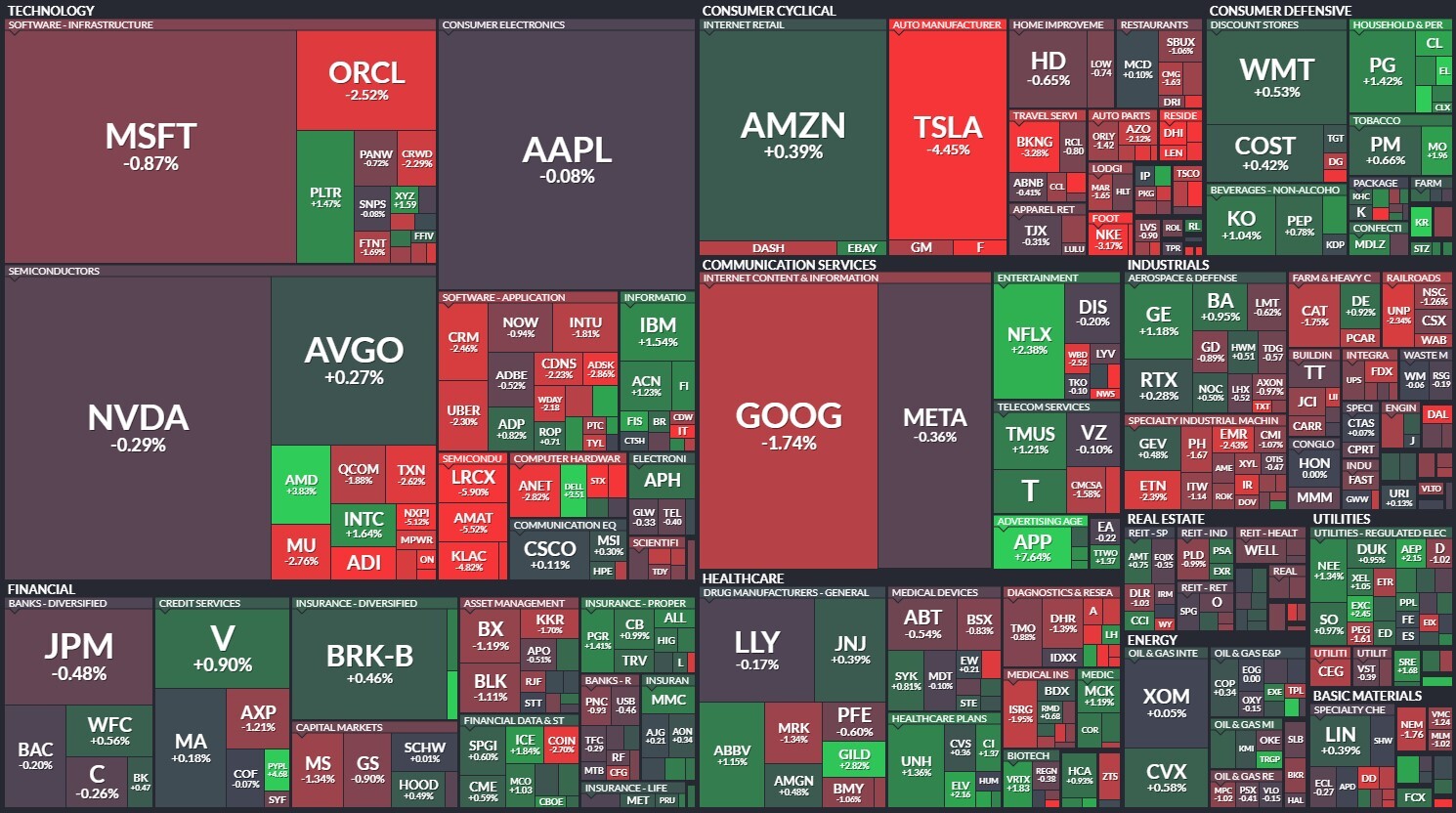
Homebuilder stocks also fell after Evercore ISI downgraded the sector, sending D.R. Horton, Lennar, and PulteGroup down more than 3%.
Winners included AppLovin (+7%) after bullish comments from Citigroup, PayPal (+4%) following the launch of its Ads Manager platform, Dell Technologies (+3%) after raising its profit outlook, and Netflix and Veeva Systems, both upgraded by analysts.
Macro Backdrop
US consumer credit rose by only $0.36 billion versus expectations of $14 billion, signaling weaker household demand. In Europe, German factory orders unexpectedly fell 0.8%, while bond yields in Germany and the UK slipped slightly.
Asian markets traded mixed: Japan’s Nikkei 225 inched up 0.01%, and China remained closed for the week-long Lunar New Year holiday.
The market faces a mix of opposing forces: enthusiasm for AI and solid earnings expectations are offset by political risks, a protracted shutdown, and cautious Fed rhetoric. Until investors get more clarity from the upcoming FOMC minutes and Chair Powell’s remarks, profit-taking after record highs is likely to continue.
Subscribe to stay up to date with the latest events in the financial markets.
Telegram: @bigstakeinvest
Twitter: @BigStakeTrades
Telegram: @bigstakeinvest
Twitter: @BigStakeTrades