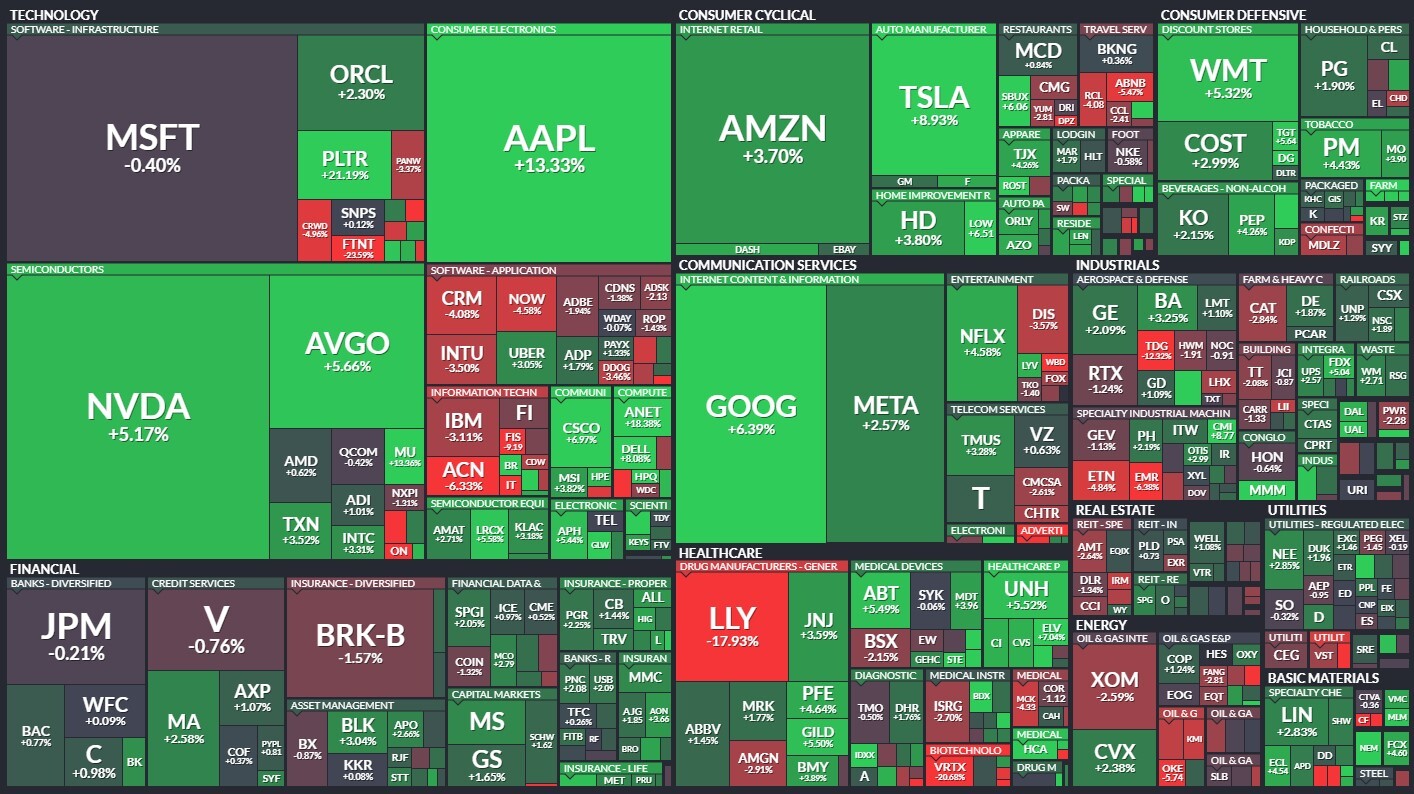
Last week on Wall Street turned into a true marathon for investors, marked by sharp market reversals, political statements, and a flood of corporate earnings reports. The market surged higher on hopes of interest rate cuts, only to slow down under the weight of tariff threats and mixed macroeconomic data.
The week began on a strong note as U.S. stock indexes rebounded from the previous Friday’s losses, with the technology sector — led by the “Magnificent Seven” and semiconductor manufacturers — once again taking the lead. Optimism was fueled by expectations that weak labor market and manufacturing data would push the Federal Reserve to ease policy as early as September. The probability of a rate cut, in the eyes of investors, jumped to nearly ninety percent.
However, by Tuesday, the euphoria faded in the wake of a weak services sector PMI and signs of price pressures. The market closed in negative territory despite strong earnings from several companies, including Palantir, which exceeded forecasts and raised its full-year guidance. The White House’s tariff rhetoric, targeting India, Canada, and a range of other trade partners, added to the unease.
Wednesday restored bullish confidence. Apple shares surged after Donald Trump announced the company’s plans to invest $100 billion in U.S. production. Arista Networks, Shopify, and several other tech players lifted sentiment with upbeat forecasts. Additional momentum came from dovish comments by Fed officials Neel Kashkari and Lisa Cook, who acknowledged signs of an economic slowdown.
Thursday was a day of contrasts. Positivity in the semiconductor sector, thanks to promised tax breaks, was offset by a sharp drop in Fortinet shares after guidance revisions and a decline in Eli Lilly stock due to weak results for a new drug. Jobless claims data signaled further labor market softening, strengthening the case for rate cuts, though cautious remarks from Atlanta Fed President Raphael Bostic tempered expectations of an imminent policy shift.
The week ended on an upbeat note. The S&P 500 and Nasdaq 100 closed at their weekly highs, with the Nasdaq hitting an all-time record. Investors were encouraged by strong results from Monster Beverage, Expedia, and Apple, as well as reports of potential progress in U.S.–Russia peace talks on Ukraine. However, steep declines in Trade Desk and Microchip Technology shares served as a reminder that earnings season can inspire — but also punish — at the slightest deviation from expectations.
In the end, the week reinforced the trend toward growing hopes of a Fed rate cut, with corporate earnings on average beating forecasts and showing the strongest pace in four years. Yet, risks remain under the surface — from trade conflicts and geopolitical uncertainty to pressure on sector-specific profits. The market continues to balance between the vision of a soft economic landing and the fear that external shocks could alter that trajectory at any moment.
The week began on a strong note as U.S. stock indexes rebounded from the previous Friday’s losses, with the technology sector — led by the “Magnificent Seven” and semiconductor manufacturers — once again taking the lead. Optimism was fueled by expectations that weak labor market and manufacturing data would push the Federal Reserve to ease policy as early as September. The probability of a rate cut, in the eyes of investors, jumped to nearly ninety percent.
However, by Tuesday, the euphoria faded in the wake of a weak services sector PMI and signs of price pressures. The market closed in negative territory despite strong earnings from several companies, including Palantir, which exceeded forecasts and raised its full-year guidance. The White House’s tariff rhetoric, targeting India, Canada, and a range of other trade partners, added to the unease.
Wednesday restored bullish confidence. Apple shares surged after Donald Trump announced the company’s plans to invest $100 billion in U.S. production. Arista Networks, Shopify, and several other tech players lifted sentiment with upbeat forecasts. Additional momentum came from dovish comments by Fed officials Neel Kashkari and Lisa Cook, who acknowledged signs of an economic slowdown.
Thursday was a day of contrasts. Positivity in the semiconductor sector, thanks to promised tax breaks, was offset by a sharp drop in Fortinet shares after guidance revisions and a decline in Eli Lilly stock due to weak results for a new drug. Jobless claims data signaled further labor market softening, strengthening the case for rate cuts, though cautious remarks from Atlanta Fed President Raphael Bostic tempered expectations of an imminent policy shift.
The week ended on an upbeat note. The S&P 500 and Nasdaq 100 closed at their weekly highs, with the Nasdaq hitting an all-time record. Investors were encouraged by strong results from Monster Beverage, Expedia, and Apple, as well as reports of potential progress in U.S.–Russia peace talks on Ukraine. However, steep declines in Trade Desk and Microchip Technology shares served as a reminder that earnings season can inspire — but also punish — at the slightest deviation from expectations.
In the end, the week reinforced the trend toward growing hopes of a Fed rate cut, with corporate earnings on average beating forecasts and showing the strongest pace in four years. Yet, risks remain under the surface — from trade conflicts and geopolitical uncertainty to pressure on sector-specific profits. The market continues to balance between the vision of a soft economic landing and the fear that external shocks could alter that trajectory at any moment.
Subscribe to stay up to date with the latest events in the financial markets.

