The third week of August 2025 turned into a real test for investors.
Throughout the week, US stock indexes swung between cautious optimism and pressure from macroeconomic headwinds. The spotlight was on President Trump’s tariff policies, Ukraine peace talks, and expectations surrounding the Federal Reserve.
The week opened quietly: both the S&P 500 and Nasdaq closed nearly flat, while 10-year Treasury yields climbed to a two-week high. Sentiment weakened further after disappointing housing market data and concerns that July’s inflation readings would prevent the Fed from cutting rates in September.
Throughout the week, US stock indexes swung between cautious optimism and pressure from macroeconomic headwinds. The spotlight was on President Trump’s tariff policies, Ukraine peace talks, and expectations surrounding the Federal Reserve.
The week opened quietly: both the S&P 500 and Nasdaq closed nearly flat, while 10-year Treasury yields climbed to a two-week high. Sentiment weakened further after disappointing housing market data and concerns that July’s inflation readings would prevent the Fed from cutting rates in September.
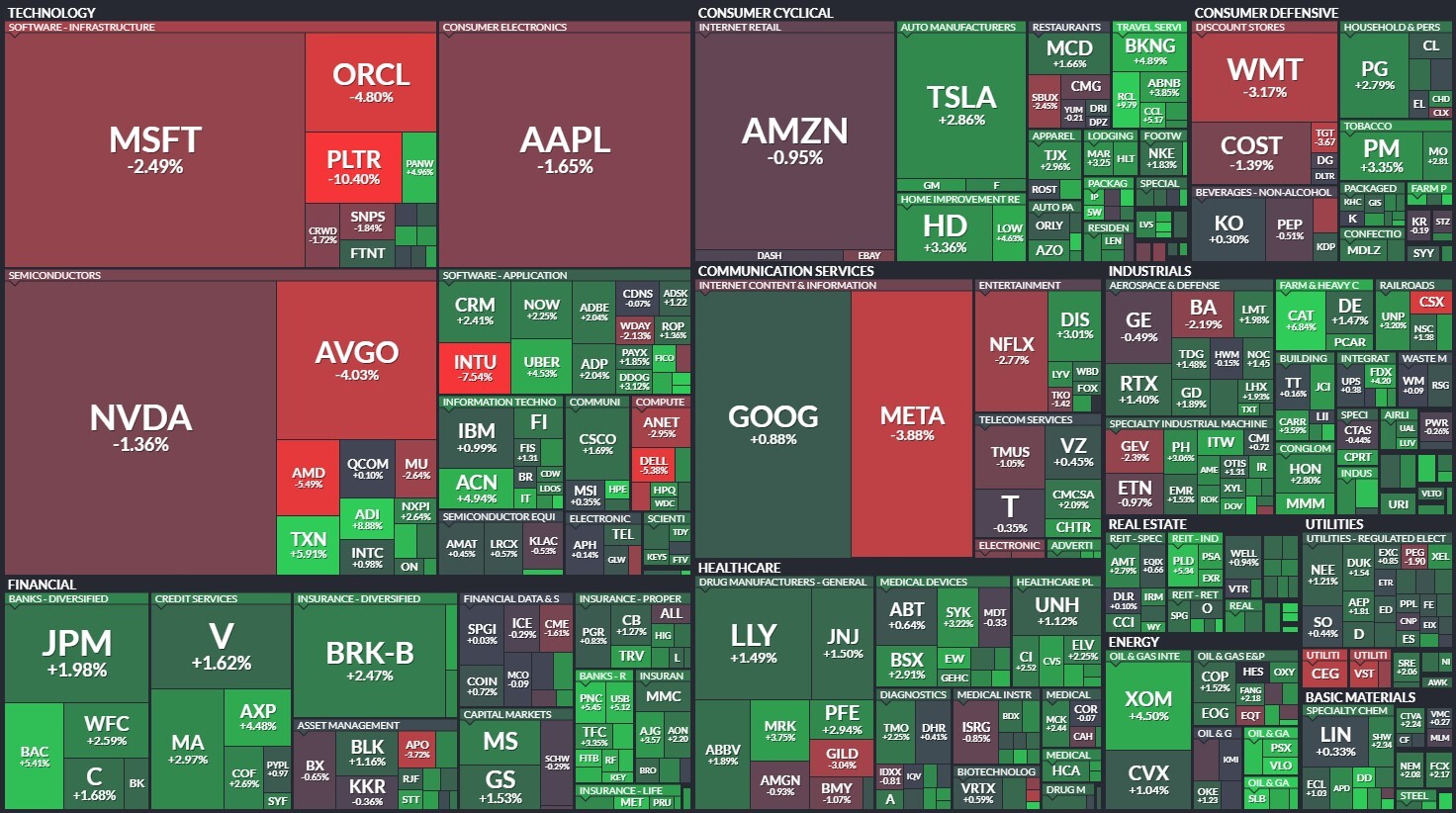
By midweek, market mood soured.
A broad selloff in technology and semiconductor stocks dragged Nasdaq to fresh lows. Disappointing forecasts from Target and Estee Lauder added to the gloom, while chipmakers like Intel and Micron extended losses. The “Magnificent Seven” megacaps, which had fueled much of the rally in recent months, became the main drag.
Fed minutes released midweek also weighed on markets. Policymakers emphasized that inflation risks remain a greater concern than labor market weakness, dampening hopes for a quick rate cut and pushing yields higher.
But Friday marked a turning point.
At the Jackson Hole symposium, Fed Chair Jerome Powell said labor market risks are rising, opening the door for a possible rate cut in September. Markets reacted with enthusiasm: the S&P 500 jumped more than 1.5%, the Dow Jones hit a record high, and Treasury yields dropped sharply. Chipmakers, airlines, and housing-related stocks led the rally.
Geopolitical developments lingered in the background but remained significant. Talks involving the US, Europe, and Ukraine continued to make incremental progress, with discussions around security guarantees and potential European troop deployments. Any breakthrough could have major implications for energy and global trade.
Trade policy also kept investors on edge.
President Trump expanded tariffs on steel, aluminum, and semiconductors, with rates reaching as high as 100–300%. Analysts now expect average US tariffs to climb to 15.2%, up from just 2.3% in 2024 — a dramatic shift that risks fueling higher consumer prices.
Corporate fundamentals, however, provided support. S&P 500 earnings for Q2 are growing over 9% year-over-year, the strongest pace in four years, with more than 80% of companies beating profit estimates. This resilience helped limit the depth of the pullback earlier in the week.
Global markets showed mixed performance.
Europe traded unevenly, while Asia posted sharp contrasts: Shanghai’s Composite surged to a 10-year high, and Japan’s Nikkei briefly reached record levels before pulling back.
The week ultimately ended on a bullish note, with Powell’s remarks giving investors confidence that the Fed may pivot toward rate cuts as early as September. This optimism sparked strong gains in technology and cyclical sectors.
Still, uncertainty lingers. Tariff escalation, geopolitical risks, and uneven inflation data remain sources of volatility. Investors now look ahead to upcoming economic reports and Fed guidance to gauge the next move.
A broad selloff in technology and semiconductor stocks dragged Nasdaq to fresh lows. Disappointing forecasts from Target and Estee Lauder added to the gloom, while chipmakers like Intel and Micron extended losses. The “Magnificent Seven” megacaps, which had fueled much of the rally in recent months, became the main drag.
Fed minutes released midweek also weighed on markets. Policymakers emphasized that inflation risks remain a greater concern than labor market weakness, dampening hopes for a quick rate cut and pushing yields higher.
But Friday marked a turning point.
At the Jackson Hole symposium, Fed Chair Jerome Powell said labor market risks are rising, opening the door for a possible rate cut in September. Markets reacted with enthusiasm: the S&P 500 jumped more than 1.5%, the Dow Jones hit a record high, and Treasury yields dropped sharply. Chipmakers, airlines, and housing-related stocks led the rally.
Geopolitical developments lingered in the background but remained significant. Talks involving the US, Europe, and Ukraine continued to make incremental progress, with discussions around security guarantees and potential European troop deployments. Any breakthrough could have major implications for energy and global trade.
Trade policy also kept investors on edge.
President Trump expanded tariffs on steel, aluminum, and semiconductors, with rates reaching as high as 100–300%. Analysts now expect average US tariffs to climb to 15.2%, up from just 2.3% in 2024 — a dramatic shift that risks fueling higher consumer prices.
Corporate fundamentals, however, provided support. S&P 500 earnings for Q2 are growing over 9% year-over-year, the strongest pace in four years, with more than 80% of companies beating profit estimates. This resilience helped limit the depth of the pullback earlier in the week.
Global markets showed mixed performance.
Europe traded unevenly, while Asia posted sharp contrasts: Shanghai’s Composite surged to a 10-year high, and Japan’s Nikkei briefly reached record levels before pulling back.
The week ultimately ended on a bullish note, with Powell’s remarks giving investors confidence that the Fed may pivot toward rate cuts as early as September. This optimism sparked strong gains in technology and cyclical sectors.
Still, uncertainty lingers. Tariff escalation, geopolitical risks, and uneven inflation data remain sources of volatility. Investors now look ahead to upcoming economic reports and Fed guidance to gauge the next move.
Subscribe to stay up to date with the latest events in the financial markets.
Telegram: @bigstakeinvest
Twitter: @BigStakeTrades
Telegram: @bigstakeinvest
Twitter: @BigStakeTrades