Market Shifts Back to Risk-On Mode
Monday brought a powerful rebound for US equities: the S&P 500 climbed roughly 1.5%, the Nasdaq 100 jumped over 2%, and the Dow Jones followed modestly higher. December futures for both S&P and Nasdaq confirmed the momentum, signaling renewed appetite for risk. The key catalyst was political progress toward reopening the federal government: a bipartisan coalition emerged in the Senate, and the White House swiftly backed the deal. Markets interpreted this as a reduction in political uncertainty and a potential boost for growth and corporate confidence.
Politics as Catalyst and Risk
The seventh week of the government shutdown — the longest in history — paradoxically became a turning point. Hopes for an imminent reopening drove buyers back into equities. The House is expected to move quickly once the Senate approves the bill, which provides full-year funding for several departments, temporary funding for others, compensation for furloughed workers, and the resumption of payments to states and municipalities. This framework effectively removes one of the key growth headwinds. Risks remain, but the probability of a prolonged fiscal freeze has fallen sharply.
Fed: Dovish and Hawkish Voices in One Day
Comments from Federal Reserve officials added to volatility but ultimately supported equities. San Francisco Fed President Mary Daly emphasized a softening labor market and contained service inflation, warning against keeping rates “too high for too long” and causing unnecessary damage to the economy. Her remarks eased fears of an overly restrictive Fed. In contrast, St. Louis Fed President Alberto Musalem said he expects a “substantial rebound” in the economy next quarter and sees limited room for further rate cuts without becoming overly accommodative. Investors took the mixed tone as confirmation that the Fed remains data-dependent, leaving room for flexibility while not committing to an easing path.
Bond Yields and Auctions: Selective Demand for Duration
The 10-year Treasury yield rose slightly as investors shifted capital into equities, reducing safe-haven demand. Still, the Treasury’s 3-year note auction drew strong demand, with a bid-to-cover ratio at a two-year high, reflecting appetite for shorter-duration paper amid lingering uncertainty over the yield curve. Treasuries retain underlying support from the ongoing shutdown and rate-cut expectations, though long-end demand is capped by improving growth prospects.
Global Markets and Macro Context
European markets followed Wall Street higher, reinforcing the global risk-on mood. However, the Eurozone’s investor sentiment index unexpectedly weakened, signaling persistent fragility in regional growth. Bond yields in Germany and the UK moved in opposite directions but without major shifts, providing a stable backdrop for equity valuations.
Sector Highlights: AI Infrastructure and the Magnificent Seven Lead the Way
Semiconductors and AI-related infrastructure stocks powered the rally. Micron and Western Digital surged, AMD and chip equipment makers advanced, and Nvidia led the charge. The “Magnificent Seven” megacaps also supported the rally — Tesla and Alphabet rose more than 3%, while Amazon, Meta, and Microsoft gained over 1%. Apple lagged slightly but still ended higher. Meanwhile, gold producers spiked alongside a 2% jump in COMEX gold, signaling a rare mix of risk appetite and safe-haven demand often seen at turning points in market sentiment.
Corporate Highlights: M&A, Upgrades, and Executive Moves
Stock-specific catalysts played a large role. Upgrades and raised price targets fueled gains in pharma and semiconductor names, while M&A headlines sparked revaluations in older industrial segments. On the flip side, disappointing guidance and sudden executive changes dragged several companies lower. Logistics firms like FedEx and UPS fell as they grounded fleets following last week’s fatal cargo plane crash in Kentucky.
Healthcare Insurers Under Pressure
The healthcare insurance sector lagged sharply as the potential government reopening did not include new funding or policy relief. Investors took profits after prior gains, wary of uncertainty in reimbursement rates and budget allocations. The selloff underscored how sensitive defensive sectors remain to shifts in fiscal policy.
Earnings Season
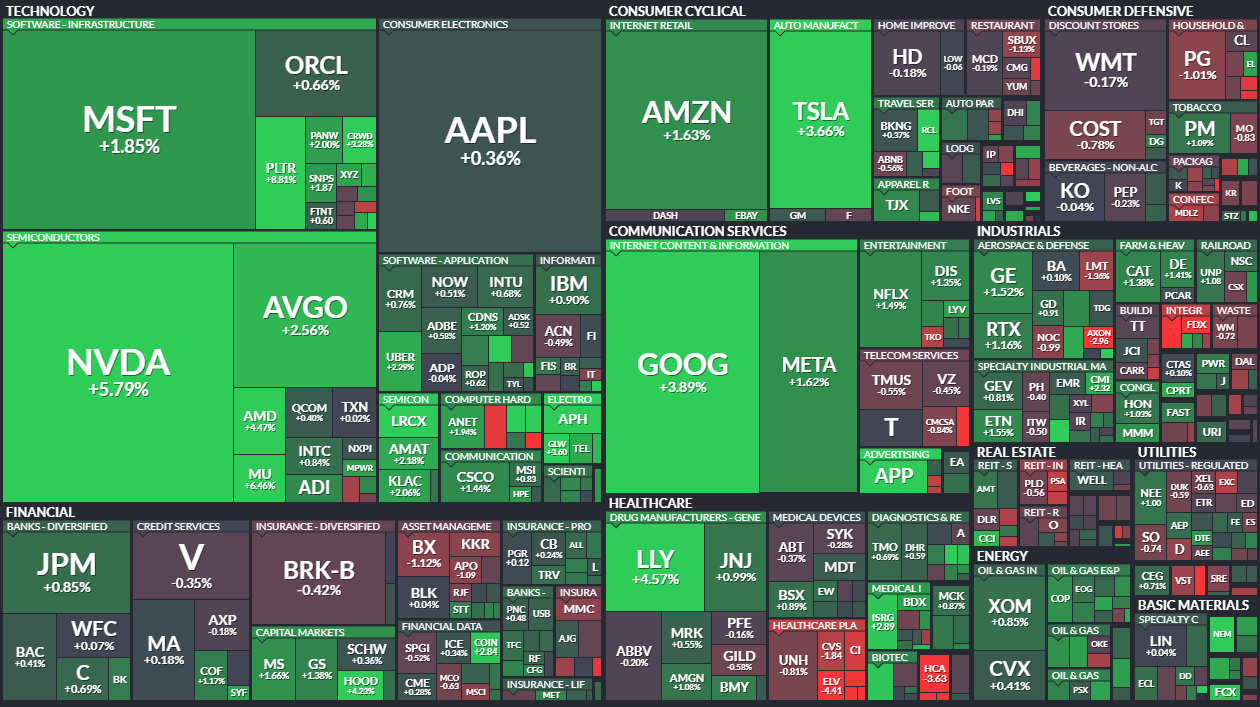
As Q3 earnings season nears completion, 82% of S&P 500 companies have beaten estimates — the highest rate since 2021. Profit growth of nearly 15% has more than doubled initial expectations, reinforcing the “soft landing” narrative and providing fundamental support for valuations even amid rate volatility.
Fed Outlook: Market Pricing Reflects Cautious Easing
Futures markets now price roughly a 63% probability of a 25 bp rate cut at the December FOMC meeting. Investors increasingly expect a gradual and data-driven easing path rather than an aggressive cutting cycle. That keeps equities sensitive to incoming inflation and employment data but still underpinned by strong earnings and capital expenditure trends.
What It Means for Investors
Technically, the market has reclaimed key short-term support levels and signaled potential for renewed upside, particularly in growth and AI-related names. Fundamentally, the political backdrop is cleaner, the earnings base stronger, and the monetary picture more flexible. Yet structural questions — from disinflation speed to the shape of the yield curve — remain open. In this environment, investors can focus on two practical anchors: disciplined exposure to productivity-driven tech sectors and hedging through duration or gold in case of renewed uncertainty. This balance allows participation in the rally without losing risk control.
Subscribe to stay up to date with the latest events in the financial markets.
Telegram: @bigstakeinvest
Twitter: @BigStakeTrades
Telegram: @bigstakeinvest
Twitter: @BigStakeTrades